
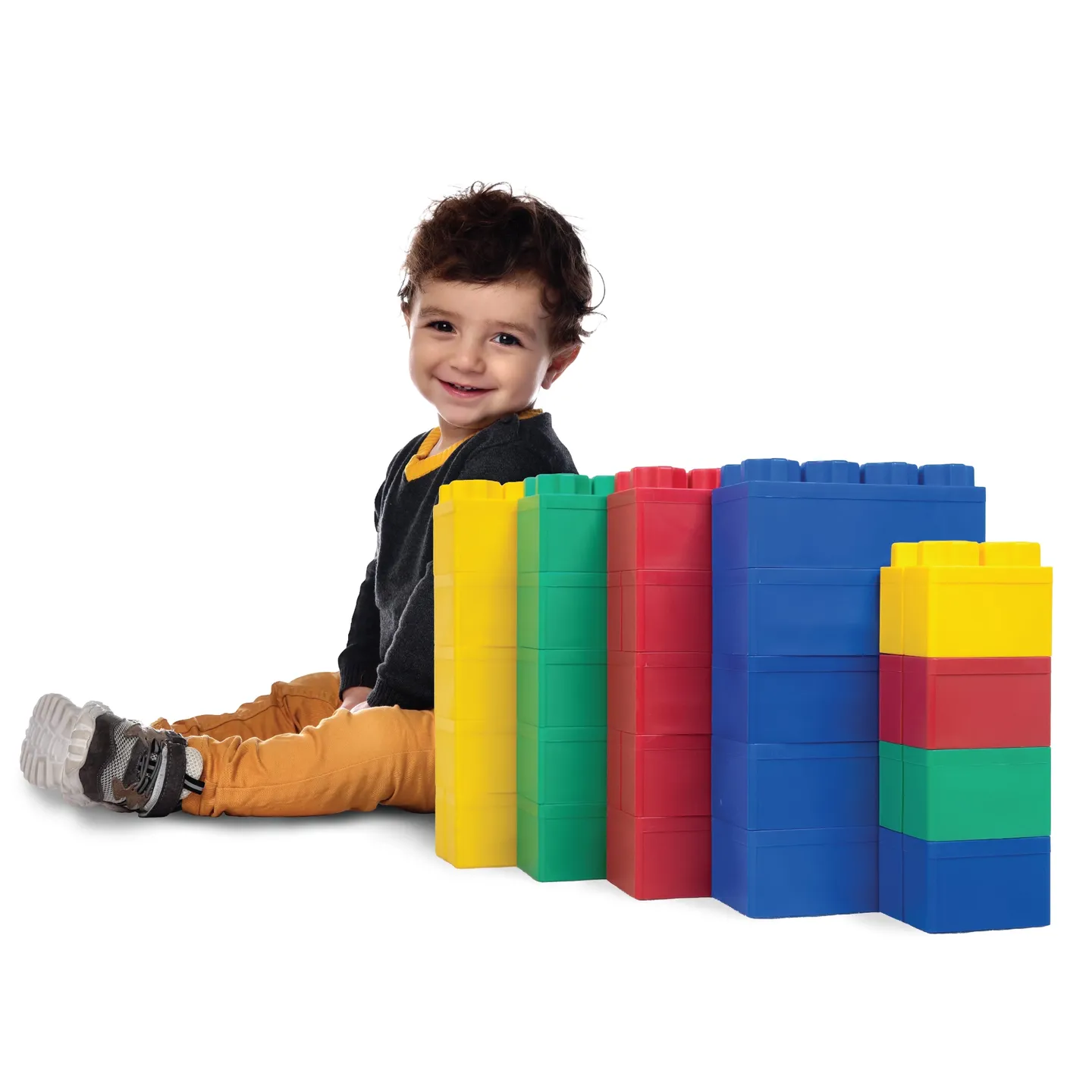
Giant Building Blocks are a wonderful way to encourage children to turn simple ideas into creative structures. Giant Building Blocks give young builders the freedom to design castles, houses, towers, bridges, and imaginative worlds without being restricted to one specific design. With Giant Building Blocks, children can explore construction through hands-on experimentation while developing creativity, coordination, and problem-solving skills. Whether used at home, school, daycare, or a play center, Giant Building Blocks can transform ordinary playtime into an engaging building experience.
The Creative Power of Imaginative Building
Imaginative building allows children to create something based on their own ideas rather than simply following instructions. This type of open-ended play gives them the freedom to decide what they want to construct, how it should look, and what purpose it will serve.
Large construction pieces make this experience especially exciting because children can create structures that are easy to see, explore, and incorporate into pretend games. A tower can become a magical castle, while a collection of blocks can become a train station, animal shelter, or futuristic city.
Encouraging Original Ideas
Every child approaches construction differently. One child may focus on creating a tall structure, while another may prefer building a detailed home for toy characters.
Giant Building Blocks allow these different interests to develop naturally. Children can experiment with colors, shapes, arrangements, and sizes while creating structures that reflect their individual imagination.
How Giant Building Blocks Support Creativity
Giant Building Blocks provide an open-ended platform for creative expression. There is rarely a single correct result, which means children can continuously change and improve their designs.
If a structure does not work, children can take it apart and try again. This process teaches them that mistakes are part of creative development rather than something to fear. For more information about large building blocks for kids, explore their features, benefits, age suitability, and role in encouraging imaginative and educational play.
Developing Problem-Solving Skills
Construction requires children to make decisions. They may need to determine which pieces should form the base, how to make a tower stable, or how to connect two sections.
These small challenges encourage logical thinking. Children learn through observation and trial and error as they discover which building methods produce better results.
Learning Through Experimentation
Experimentation is an important part of imaginative construction. Children can test different arrangements and see how changing one piece affects the entire structure.
Giant Building Blocks make this process accessible because large pieces are straightforward to move and rearrange. Children can quickly modify their designs and immediately observe the outcome.
Building Skills Through Hands-On Play
Construction play combines creativity with physical activity. Children must pick up pieces, carry them to a building area, position them, and carefully place them into their structures.
These actions can help strengthen hand-eye coordination and spatial awareness. Children also become more aware of how objects fit together and how different positions affect the overall structure.
Fine Motor and Coordination Skills
Although the pieces are large, children still need to control their movements when placing them accurately. Repeated building and rebuilding can provide opportunities to practice coordination.
The activity can be particularly engaging because children are developing these skills while working toward a goal they have chosen themselves.
Spatial Awareness
Large construction toys can introduce children to concepts such as height, width, distance, position, and balance. As children build, they begin to understand how different components relate to each other.
They may discover that a wider base creates greater stability or that adding too much weight to one side can cause a structure to lean.
Creative Structures Children Can Build
The possibilities with Giant Building Blocks are almost limitless. Giving children different construction challenges can help them discover new ways to use the same pieces.
Castles and Fortresses
Children can create castles with towers, walls, gates, and imaginary rooms. Once the structure is finished, it can become the setting for a fantasy adventure.
Adding toy figures can encourage storytelling and role-playing. Children can invent characters, create conflicts, and develop their own imaginative narratives.
Houses and Villages
A house-building activity can introduce children to the idea of rooms and spaces. They can create bedrooms, kitchens, entrances, and pretend gardens.
Several children can work together to build an entire village. Each child can construct a different building and then connect the structures into one larger imaginary community.
Bridges and Towers
Bridge construction introduces simple ideas about balance and support. Children can experiment with different foundations and arrangements to determine which designs remain stable.
Towers provide another fun challenge. Children can see how high they can build while maintaining a strong base.
Giant Building Blocks for Collaborative Play
Construction becomes even more valuable when children work together. Collaborative building encourages them to communicate their ideas, share pieces, and coordinate their efforts.
One child may build the foundation while another creates the upper section. This type of teamwork teaches children that different contributions can combine to create a larger result.
Communication and Cooperation
Group projects require children to listen to one another and discuss their plans. They may need to decide where a particular piece should go or agree on the overall design.
These interactions can help develop communication skills while encouraging patience and cooperation.
Family Construction Activities
Parents can also participate in building projects. Instead of taking over the construction, adults can ask questions and encourage children to lead.
A family project might involve creating a giant castle, pretend airport, animal park, or transportation center. Such activities can turn construction into a shared experience.
Turning Construction Into Storytelling
One of the most effective ways to expand imaginative building is to connect structures with stories. After creating a building, ask children who lives there and what happens inside.
A simple block structure can quickly become a pirate ship, rescue center, secret laboratory, or space station. This encourages children to use their language and imagination while continuing to interact with their creation.
Creating Adventure Scenarios
Giant Building Blocks can become part of themed adventures. Children might build a rescue station and pretend to help characters in trouble.
Another activity could involve constructing a space base for imaginary astronauts. These scenarios give children a reason to keep modifying their structures as the story develops.
Educational Opportunities Through Construction
Imaginative building can support early learning in many ways. Parents and educators can introduce counting, sorting, colors, shapes, and measurements during construction without turning play into a formal lesson.
For example, children can count how many pieces they used or compare the heights of two towers. They can identify geometric shapes and create repeating patterns.
Introducing STEM Concepts
Construction naturally connects to early STEM learning. Children can explore balance, structure, symmetry, geometry, and basic engineering principles.
Giant Building Blocks encourage practical experimentation. Children can ask why a structure falls, test a new arrangement, and observe the result.
This hands-on approach helps make abstract concepts easier to understand because children can see and experience the principles directly.
Creating a Better Building Environment
A suitable play area can make construction safer and more enjoyable. Choose an open space where children have room to move around their creations.
Keep fragile objects and unnecessary obstacles away from the building zone. A carpet or suitable play mat can provide a comfortable surface for many indoor construction activities.
Organizing Building Pieces
Because oversized blocks can take up considerable space, an organized storage solution is useful. Large bins, open shelves, or dedicated storage areas can make cleanup easier.
Children can also participate in organizing their building pieces. Returning materials after play can encourage responsibility and help establish a simple routine.
Choosing the Right Giant Building Blocks
When selecting Giant Building Blocks, consider the child's age, abilities, available space, material, piece size, and number of pieces.
Younger children may benefit from lightweight pieces that are easy to handle. For classrooms or childcare environments, durability and easy cleaning may be particularly important.
Safety and Supervision
Always choose age-appropriate construction toys and follow the manufacturer's safety recommendations. Inspect pieces regularly for damage, cracks, or sharp edges.
Children should have sufficient space to build and should be encouraged not to climb unstable structures. Younger children may require closer adult supervision during construction activities.
Keeping Imaginative Building Fresh
One advantage of Giant Building Blocks is that the same pieces can be used repeatedly in completely different ways. A castle can be dismantled and transformed into a city, while a tower can become part of a pretend space station.
Parents and educators can rotate creative challenges to maintain interest. Themes such as “build a zoo,” “design a rescue station,” “create a fantasy village,” or “make a giant bridge” can inspire new projects.
This variety ensures that construction remains an evolving creative activity rather than a one-time project.
Frequently Asked Questions
1. What are Giant Building Blocks?
Giant Building Blocks are oversized construction pieces designed for children to stack, arrange, connect, and use in creative structures and imaginative play scenarios.
2. What can children build with Giant Building Blocks?
Children can build towers, castles, houses, bridges, tunnels, villages, cities, garages, space stations, animal shelters, and many other imaginative creations.
3. Do Giant Building Blocks help child development?
Yes. Construction play can support creativity, coordination, spatial awareness, problem-solving, planning, communication, teamwork, and early STEM learning.
4. Can multiple children use Giant Building Blocks together?
Yes. Collaborative construction gives children opportunities to share materials, communicate ideas, divide tasks, solve problems, and work toward a common goal.
5. How can parents encourage imaginative building?
Parents can provide open-ended challenges, ask questions about children's designs, introduce storytelling themes, and allow children to experiment rather than requiring them to copy a specific structure.
Conclusion
Giant Building Blocks provide a flexible foundation for imaginative building and meaningful play. Their oversized format allows children to create structures that become part of their pretend environments, from castles and villages to bridges, towers, and futuristic cities. More importantly, construction encourages children to experiment, solve problems, communicate, and develop confidence in their own ideas. With an appropriate play area, creative challenges, and age-appropriate safety practices, Giant Building Blocks can offer children countless opportunities to build, imagine, explore, and learn. The simple act of arranging large pieces can become the starting point for stories, adventures, educational discoveries, and creative projects that change every time a child begins building.